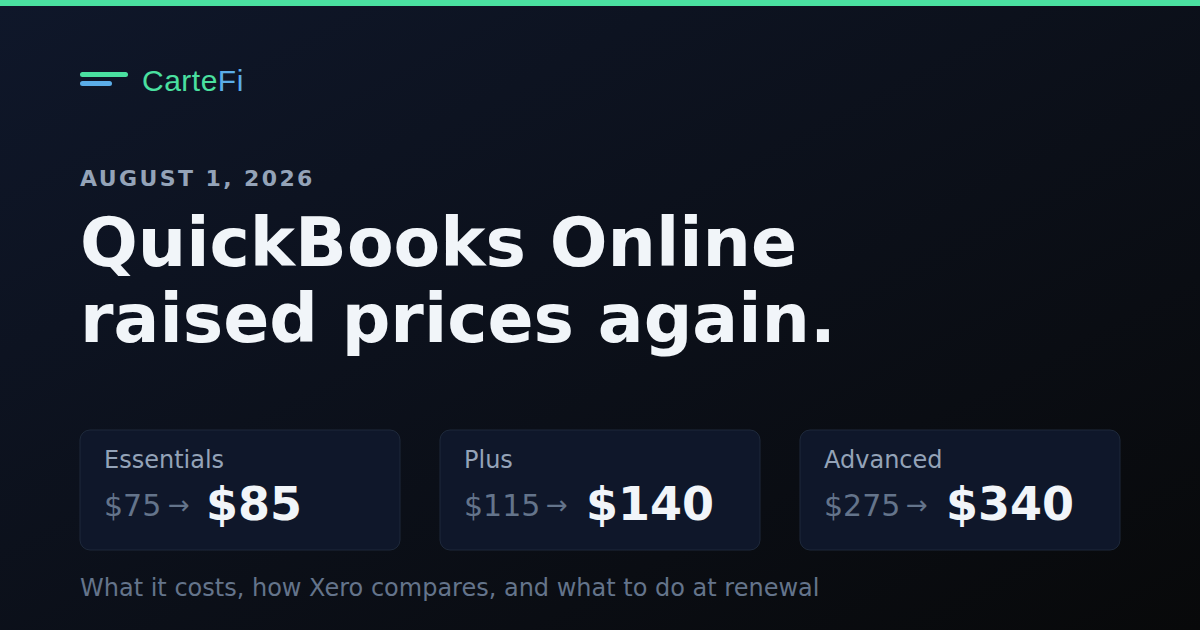
The August 1 QuickBooks Online price increase took effect yesterday. Advanced subscribers just picked up an extra $65 per month. Plus went up $25. Essentials climbed $10. Simple Start held flat, along with the newer Free, Lite, and Ledger tiers.
Annualized, that’s $780 more per year on Advanced, $300 on Plus, $120 on Essentials. For most small businesses running QBO, this is the fourth consecutive summer of price increases.
Below is the actual math on what QuickBooks Online now costs, how Xero compares as the mainstream alternative, and where a QuickBooks alternative built on modular pricing fits into the picture.
New QuickBooks Online Prices Effective August 2026
Intuit is applying the new pricing at your next billing date, per Intuit’s Firm of the Future price change announcement. One wrinkle: the QuickBooks website itself won’t display the new numbers until August 3, so anyone comparing QBO plans this week is likely still seeing pre-hike figures on quickbooks.intuit.com. What’s actually being billed:
- Essentials: $85/month (previously $75)
- Plus: $140/month (previously $115)
- Advanced: $340/month (previously $275)
Advanced customers get the sharpest end of this. $780 a year is the tuition Intuit is charging existing subscribers to keep using the product they’ve already been paying for.
New subscribers hold their intro rate until their seventh invoice, which is where the increase lands. Existing subscribers see it at their next renewal, whatever date that falls on. Check the Subscriptions and Billing page under the gear icon for your specific number.
Simple Start ($38), Ledger, Lite, and Free are unchanged. Intuit’s stated logic is that those tiers serve early-stage clients they aren’t squeezing yet.
What Intuit Says the Price Hike Pays For
The public framing is that the money funds Intuit Intelligence, a bundle of AI features shipping through August. What’s in it:
- AI transaction categorization with a human review step Intuit is calling “validation”
- Rebuilt bank feeds that Intuit says are more reliable
- Invoice drafts generated from natural-language prompts
- Ask-your-books queries in plain English
- Bill Pay Elite bundled into Advanced at no extra charge (previously $540/year separately)
- Workforce Elite payroll folded into Advanced (previously a paid add-on)
- Construction and professional-services-specific tools added to Advanced, valued by Intuit at $900/year
Whether any of that actually delivers depends on which G2 and Capterra reviews you’re reading. The pattern in QBO reviews over the past six months has been consistent. AI categorization still mis-categorizes. Bank feed breaks persist. “Improved reporting” often means the same reports reorganized. Users who report satisfaction tend to be the ones not relying on the newer features. Users who are angry are the ones paying more for tools they didn’t ask for and can’t trust with their books.
Historical context: NerdWallet’s pricing analysis through 2025 showed QBO tiers climbing 11.9% to 17.3% annually since 2023, with Advanced increasing fastest. August 2026 broke that pattern to the upside. A Plus subscriber paying roughly $90 in 2023 is now at $140, a 56% cumulative increase. Advanced went from $200 to $340 over the same window. 70% in three years for a product doing the same core job.
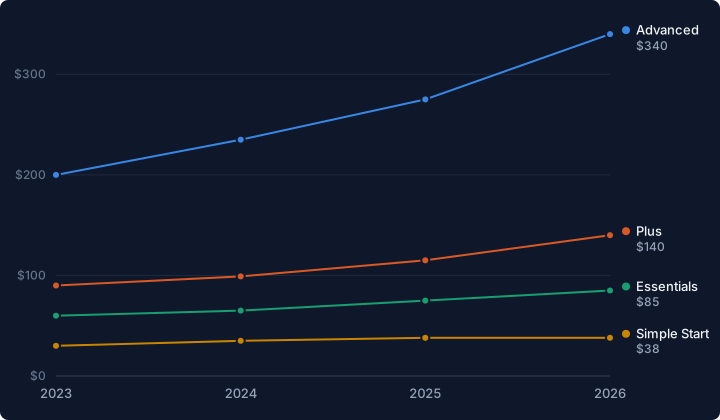
View this chart as a table
| Tier | 2023 | 2024 | 2025 | 2026 |
|---|---|---|---|---|
| Simple Start | $30 | $35 | $38 | $38 |
| Essentials | $60 | $65 | $75 | $85 |
| Plus | $90 | $99 | $115 | $140 |
| Advanced | $200 | $235 | $275 | $340 |
QuickBooks vs Xero Pricing: The Real Cost Comparison
Xero is the natural comparison if you’re evaluating a QuickBooks alternative in 2026. US pricing on their three plans:
- Early: $25/month, capped at 20 invoices and 5 bills
- Growing: $55/month, unlimited invoices and bills
- Established: $90/month, adds project tracking, multi-currency, expense claims, and analytics
The structural difference from QBO is that every Xero plan includes unlimited users. QBO Plus at $140 caps you at 5 seats. Advanced at $340 gets you to 25. A five-person business on QBO Plus is already at the ceiling, paying $140. That same business on Xero Growing pays $55 with room to add anyone else who needs access.
The catch with Xero is that a lot of core workflow lives in paid marketplace apps. Payroll runs through Gusto at $49/month plus $6 per employee, so a five-person team is closer to $79. Inventory means Cin7 Core at $349 per user per month, or Unleashed starting at $399. Receipt capture is included on every Xero plan through Hubdoc, now being folded into Xero’s own branding as Smart Document Capture, though firms wanting deeper document workflows still end up on Dext at $31.50/month. Project tracking is native to Established, but anyone needing real job costing and quoting depth tends to bolt on a dedicated tool anyway.
Real-world total cost for most SMBs on Xero lands between $105 and $205/month once the marketplace apps are factored in. That’s cheaper than QBO Plus at $140 plus add-ons, and substantially cheaper than QBO Advanced at $340.
Two things worth being straight about with Xero. Their US pricing has crept up in the last two years, though not as aggressively as Intuit’s. And their reliance on marketplace apps means switching costs are higher than they appear, because your workflow ends up spread across three or four separate vendor relationships.
Why QuickBooks and Xero Both Keep Raising Prices
Look at both products over five years and the pattern is nearly identical. Annual price increases. Features shuffled between tiers. New required add-ons appearing. AI capabilities positioned as the reason for the next hike. Intuit isn’t uniquely predatory here. Per-tier subscription pricing gives every accounting software vendor the same incentive to squeeze existing customers every summer.
When your accounting platform is a subscription, price isn’t a fixed cost. It’s a moving target that trends up every year. Vendors have learned they can raise prices roughly 10 to 15% annually and only lose the customers who were already leaving. So they raise them.
Xero at least addresses the per-seat problem with unlimited users on every plan. That’s a genuine advantage over QBO. What it doesn’t fix is the tier-migration problem. Features that used to be in Growing get moved to Established over time, and Xero customers end up pushed up the ladder whether they wanted to be or not.
The other structural response is modular pricing. Pay for what you actually use, add features when you need them, don’t subsidize the ones you don’t. That’s how CarteFi is built.
CarteFi: A Modular Pricing QuickBooks Alternative for Small Businesses
CarteFi is accounting software built for small businesses that want out of the annual-hike cycle. CarteFi pricing works differently than QBO or Xero.
The base plan is $15/month. That includes your first full user and the whole accounting engine: invoicing, bill pay, reconciliation, reporting, and standard integrations.
Additional full users cost $6/month each. No seat cap, no forced upgrade to a higher tier.
Concrete comparison for a five-person business, all with full access:
| Software | Base plan | User cost | Total monthly |
|---|---|---|---|
| QBO Plus (post-hike) | $140 | Up to 5 users included | $140 + add-ons |
| Xero Growing | $55 | Unlimited included | $55 + marketplace apps |
| CarteFi | $15 | $6 × 4 additional = $24 | $39 |
Being straight about the tradeoffs: CarteFi is a newer product. QBO has two decades of ProAdvisor networks, integrations, and ecosystem depth. If your CPA won’t work in anything but QuickBooks, that’s a real switching cost we won’t argue you out of. And CarteFi isn’t the right fit for every business. Inventory-heavy retail, multi-entity consolidation, and enterprise workflows are outside our lane. If that’s you, Sage Intacct or NetSuite is a more honest recommendation than CarteFi.
If you’re staring at a $25 to $65 monthly increase on a QuickBooks bill that was already too high, we built CarteFi for you.
What to Do Before Your Next QuickBooks Renewal
Three things worth doing this week if you’re on Essentials, Plus, or Advanced:
Check your renewal date. Under the gear icon, Subscriptions and Billing. The renewal date determines exactly when the price increase applies to your account. New subscribers hold the intro rate until their seventh invoice, so if you signed up in April 2026, that seventh bill lands in October and it’s the first one at the new rate.
Audit your tier. A lot of Plus subscribers ended up there years ago when an Intuit rep talked them up from Essentials, not because they use the Plus features. If you’re not using inventory tracking, project profitability, or class tracking, Simple Start may be enough. Downgrading before your renewal locks in a lower base cost immediately.
Try alternatives before you commit to another year. Xero and CarteFi both offer trials. Switching costs feel bigger in your head than they usually are on paper. QBO data migration is mature and documented for both. Team retraining is real, but it’s a one-time cost. Price increases are recurring.
Frequently Asked Questions
How much did QuickBooks Online prices go up in August 2026?
Essentials increased $10/month (to $85), Plus increased $25/month (to $140), and Advanced increased $65/month (to $340). Simple Start, Ledger, Lite, and Free are unchanged. Annualized, existing subscribers on Essentials, Plus, and Advanced face $120, $300, and $780 in additional cost respectively.
When does the QuickBooks price increase actually hit my account?
At your next renewal on or after August 1, 2026. Subscriptions managed through Intuit’s Solution Provider program see the change on renewals from September 1 instead. New subscribers hold their intro rate until the seventh invoice, which is the first one billed at the new rate.
Can I lock in the old QuickBooks Online pricing?
Not through Intuit directly. Once your renewal date passes August 1, you’re on the new pricing. Your only options are switching platforms before the increase applies to you, or downgrading to a tier that wasn’t affected (Simple Start, Ledger, Lite, or Free).
Is Xero cheaper than QuickBooks Online?
On base price, yes. Xero Growing at $55 is well below QBO Plus at $140. Real total cost depends on the marketplace apps you end up needing. Xero’s unlimited-user model is a meaningful advantage for teams over five people, since QBO Plus caps at five and Advanced is the next step up at $340.
What’s the best QuickBooks alternative for small businesses in 2026?
Depends on the workflow. Xero is the mainstream option with strong ecosystem depth and unlimited users on every plan. CarteFi is a newer modular-pricing option built for small businesses that don’t want to pay for tiers of features they don’t use, and the CarteFi vs QuickBooks comparison breaks down the cost difference by team size. Wave and FreshBooks fit narrower use cases (freelancers, service-based sole proprietors). For inventory-heavy or multi-entity businesses, Sage Intacct and NetSuite are the more appropriate targets.
Will QuickBooks Online raise prices again in 2027?
Almost certainly. Intuit has raised prices every summer since 2023. If the pattern holds, expect Plus above $165 and Advanced pushing $400 by August 2027.
CarteFi is a general-ledger accounting platform built for small businesses that want out of the annual price-hike cycle. Check the pricing calculator and see what you would actually pay compared to your current QuickBooks or Xero setup.